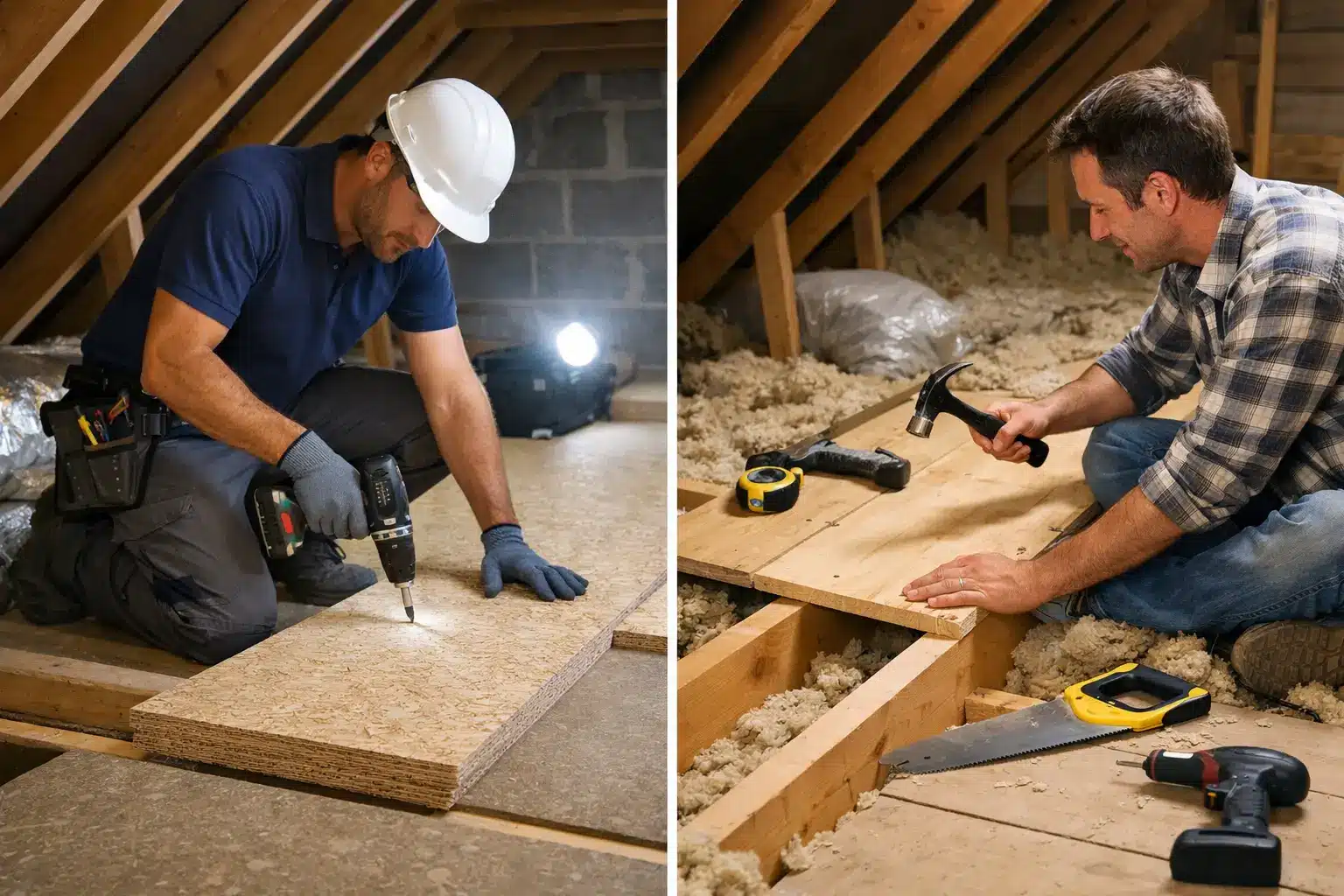
You usually notice the limits of a loft at the worst moment – when wardrobes are full, the spare room has become a storage dump, and the Christmas boxes are balancing on ceiling joists. That is when professional installation vs DIY loft boarding stops being a simple budget question and becomes a decision about safety, storage quality and whether the job will actually serve your home for years.
For some households, DIY loft boarding can work well. For others, it creates more problems than it solves, especially where insulation is compressed, wiring is boxed in badly, or the new floor is laid directly onto joists that were never intended to carry regular storage loads. The right choice depends on your loft, your property type, and how confident you are in getting the details right.
Professional installation vs DIY loft boarding – what really changes?
At first glance, both routes appear to lead to the same result: boards in the loft and more room for storage. In practice, the finished outcome can be very different.
A professionally boarded loft is usually planned around access, load distribution, insulation depth, ventilation and long-term usability. It is not just a case of laying chipboard wherever there is space. The installer will assess whether a raised system is needed, how much boarding is sensible, whether the hatch and ladder are fit for purpose, and whether the loft can be used safely without affecting the performance of insulation.
DIY jobs often start with the visible need – more floor area – but miss the hidden constraints. Modern homes in particular can be less forgiving. New-build lofts often have deeper insulation, lighter trussed roof structures and warranty considerations that homeowners may not realise apply to loft alterations. Older homes bring a different set of challenges, from uneven joists to outdated electrics and awkward roof geometry.
That is why the debate is not really about whether you can board a loft yourself. It is about whether you can do it to a safe, durable standard that protects the home rather than creating a tidy-looking problem overhead.
Cost matters, but so does what you are paying for
DIY loft boarding is often chosen because the initial outlay looks lower. If you buy boards, basic fixings and a few tools, the headline price can seem attractive compared with a professional quotation. That said, the comparison is rarely as simple as materials versus labour.
A proper installation may include a raised boarding system, strengthened access, loft ladder fitting, hatch work, insulation adjustments, lighting and a layout that makes the best use of available space. You are paying for survey work, product choice, skilled fitting and a result designed around your property rather than a one-size-fits-all approach.
With DIY, hidden costs can build quickly. Extra timber, legs or supports, better boards, insulation corrections, replacement tools, disposal of old materials and time spent fixing mistakes all add up. If the finished boarding later needs to be removed and redone properly, the cheap option stops looking cheap.
There is also the cost of compromise. A loft that is awkward to access, only partly boarded well, or risky to walk on is not giving full value, even if the materials were inexpensive.
When DIY can make financial sense
If you have a very straightforward loft, reasonable practical skills and no need for a raised system or access upgrades, DIY can be a sensible route. This tends to apply more often in small areas intended for light, occasional storage rather than a fully usable loft storage platform.
Even then, it is worth being honest about what you want from the space. If you expect regular access, neat finishing and maximum safe storage, professional fitting usually provides better long-term value.
Safety is where the gap often widens
Lofts are unforgiving places to work. Restricted headroom, uneven footing, poor lighting and exposed wiring turn a simple weekend job into something more demanding than many homeowners expect.
The most obvious safety issue is falling through the ceiling. Step in the wrong place and you are not landing on a floor – you are likely going through plasterboard. Beyond that, there are electrical risks, awkward manual handling and the challenge of moving boards and tools through a small hatch.
Professional installers work in lofts every day. They know how to board around cables, pipework and awkward roof trusses. They also know when a loft should not be fully boarded, or when extra access improvements are needed before the space can be used safely.
A good result is not just about the day of installation. It is about making sure the loft remains safe every time you go up there afterwards. Properly planned boarding routes, secure footing and suitable access make a real difference if you are retrieving suitcases in winter or storing household items throughout the year.
Insulation, ventilation and warranty are easy to get wrong
This is often the deciding factor in professional installation vs DIY loft boarding, especially in newer properties.
Many lofts now have insulation laid to a depth that exceeds the height of the ceiling joists. If boards are fixed directly onto those joists, the insulation gets compressed. That reduces its effectiveness and can affect your home’s energy efficiency. In some cases, poor boarding methods can also restrict airflow and contribute to condensation issues.
A raised loft boarding system is designed to create storage space above the insulation rather than crushing it underneath. That sounds simple, but the right system and installation method matter. It needs to be stable, suitable for the structure and fitted with care.
For homeowners in new-build properties around Cardiff, Newport or Bristol, there is another consideration: warranty protection. Certain loft alterations can create problems if they do not follow appropriate methods. If maintaining compliance matters, a professional survey and installation offer reassurance that a DIY approach usually cannot.
Older homes are not automatically simpler
It is easy to assume that older houses are better suited to DIY because they may have less insulation or more traditional roof structures. Sometimes that is true. Just as often, older lofts contain surprises – uneven timbers, previous alterations, poor access, outdated boarding and insulation that needs careful attention.
In those homes, professional advice can prevent a patchwork solution that stores boxes well enough for now but stores up repair costs later.
Finish and usability matter more than people think
A loft is only useful if you can use it without hassle. That means getting up there easily, moving around safely and trusting the floor beneath you.
DIY boarding often focuses on covering as much area as possible. Professional work is more likely to focus on how the space functions. That might mean creating a defined storage platform, preserving access to important areas, improving the loft hatch, fitting a proper ladder, or adding lighting so the space is genuinely practical rather than awkward.
This is where specialist installers tend to justify their cost. They are not only fitting boards. They are improving the overall storage experience.
For busy households, that matters. If your loft is difficult to access, you will use it less. If it feels stable, well lit and properly laid out, it becomes part of how the house works day to day.
Which option is right for your home?
If your loft is simple, your storage needs are light, and you are confident working safely in a restricted roof space, DIY loft boarding may be enough. The key is knowing the limits of that choice and avoiding shortcuts that damage insulation or create unsafe access.
If your loft has deep insulation, limited headroom, awkward structure, poor access, electrical obstacles or new-build warranty considerations, professional installation is usually the more sensible route. The same applies if you want a neat finish, a raised system, or a loft that feels like a proper storage area rather than a compromise.
For many homeowners, the best approach is to start with a professional assessment and then decide. A survey can tell you what your loft needs before you spend money on the wrong materials or lose a weekend trying to force a solution that does not suit the space.
That is often where specialist companies such as Loft Ins Space add the most value. The real benefit is not simply fitting boards faster. It is knowing how to make the loft safer, more usable and better suited to the home you actually live in.
A loft should make life easier, not give you one more half-finished job to worry about. If you are weighing up the two options, choose the route that gives you storage you can trust every time you open the hatch.