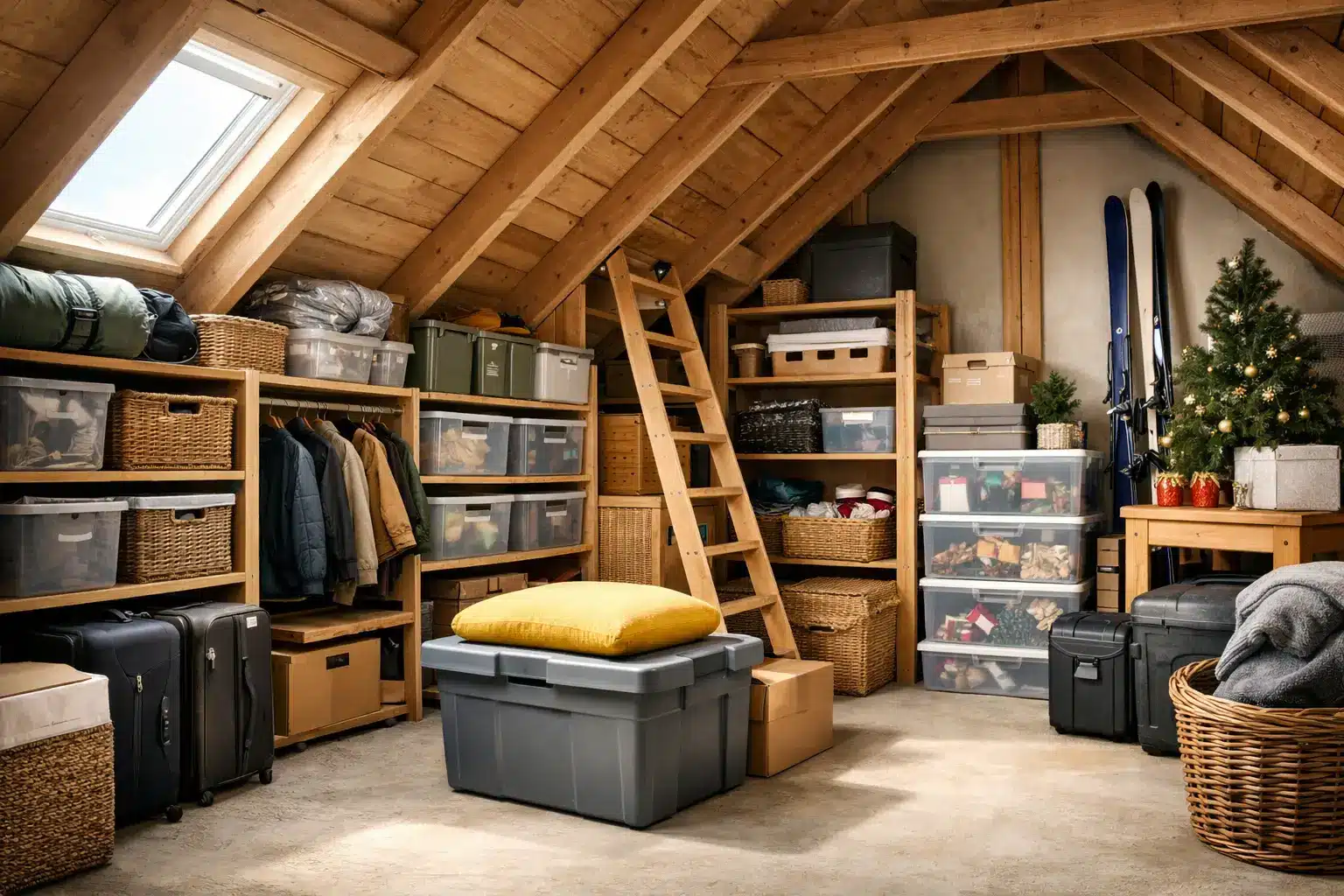
A loft can absorb far more than Christmas decorations and old paperwork, but only when it is planned as a storage space rather than treated as an empty void. The best usable attic storage ideas begin with safe access, a stable floor and enough clearance to move around without compressing the insulation beneath your feet. Get those essentials right and your loft can take the pressure off crowded bedrooms, cupboards and garages.
Start with a safe, raised storage floor
The most valuable improvement is usually a raised loft boarding system. Standard ceiling joists were not designed to carry regular foot traffic and heavy household storage on their own. Boarding laid directly over insulation can also squash it, reducing its thermal performance and leaving the home harder to heat.
A raised system creates a platform above the insulation, preserving the required depth while providing a secure surface for storage. It also makes the space more practical to use: boxes sit level, you can walk safely between areas, and items are less likely to disappear into loose insulation.
How much of the loft should be boarded depends on what you need to store and the layout of the property. A central walkway with one or two larger storage platforms can be enough for a smaller household. Families with seasonal equipment, baby items or sports kit may benefit from a wider boarded area. The right answer is not always wall-to-wall boarding. Keeping awkward eaves or restricted areas clear can make the installation more efficient while still creating meaningful capacity.
Make getting into the loft easier
A large, well-boarded loft is of little value if lifting the hatch feels unsafe or involves balancing on a chair. Improving access is one of the most practical usable attic storage ideas because it changes whether the space is genuinely used from week to week.
A properly fitted loft ladder offers safer, more reliable access than a temporary step ladder. The best option depends on ceiling height, available landing space, hatch position and how often you expect to use the loft. Folding, sliding and telescopic designs each have their place, but the ladder should feel stable underfoot and be straightforward to operate.
It is also worth considering the hatch itself. An enlarged loft hatch makes it much easier to carry boxes, suitcases and bulky items through the opening. An insulated, draught-resistant hatch helps protect energy efficiency, particularly where an older hatch is thin, poorly fitted or difficult to close securely.
Plan for a clear landing area
Leave enough unobstructed space at the top of the ladder to step off safely. This small detail matters when carrying something in both hands. If possible, position frequently used items close to the hatch, rather than at the furthest point of the loft.
Divide the loft into storage zones
The quickest way for a tidy loft to become an unusable one is to stack everything in a single pile. Create simple zones based on how often items are needed. Keep holiday decorations, camping equipment and archive boxes in the less accessible areas. Place suitcases, prams, seasonal clothing and household supplies nearer the hatch if they are likely to be retrieved more often.
Clear, lidded plastic boxes are usually a sensible choice. They protect contents from dust better than cardboard, are easier to stack and let you identify what is inside without opening every container. Cardboard may still suit lightweight, dry items that are rarely handled, but avoid using damaged or damp boxes in a loft environment.
Labels should be visible from the walkway, not just on the lid. A brief label such as “winter bedding”, “children’s keepsakes” or “garden cushions” saves time later. For larger households, a simple list on your phone of what is stored in each zone can prevent unnecessary rummaging.
Use eaves space thoughtfully
Eaves can be excellent for low-profile storage, but they are rarely suitable for heavy, frequently accessed boxes. Their limited height makes lifting and moving awkward, and the roof structure may restrict where items can go.
Use these areas for lightweight belongings such as artificial trees, spare duvets, wrapping paper or folded luggage. Long, shallow containers can make the most of the space without forcing you to crawl too far beneath the roof slope. Do not push boxes tightly against the roof covering or block essential ventilation routes. A loft needs airflow to help manage condensation and protect the fabric of the building.
Keep clear of services and roof elements
Pipes, cables, water tanks, extractor ducts and roof supports all need appropriate clearance. Never rest boxes on electrical cables or place heavy items where they could damage pipework. If your loft contains older wiring, uncertain structural details or signs of leaks, ask a qualified professional to assess the situation before installing boarding or filling the space.
Add lighting before you fill the space
A battery torch is fine for an occasional visit, but it is not a good long-term solution for a storage area. Proper loft lighting makes the space safer, easier to organise and far more likely to be used.
A switched light close to the hatch is the starting point. Additional fittings along a walkway or around a larger boarded area can be worthwhile, especially where the loft has little natural light. LED lighting is a practical choice because it is bright, energy-efficient and produces less heat than older alternatives.
Electrical work should be completed properly and positioned so that fittings and cables remain protected from stored items. Good illumination also helps you spot early signs of a problem, such as staining, pest activity or displaced insulation.
Store the right things, not everything
Lofts are ideal for clean, dry, lightweight belongings that are needed occasionally. They are less suitable for valuables sensitive to temperature changes, important paper records, delicate electronics, paint, aerosols or anything that could leak, freeze or overheat. If your loft becomes very hot in summer or cold in winter, treat it as a storage area, not an extension of the living space.
Be especially cautious with weight. Books, tiles, gym equipment and full toolboxes become very heavy surprisingly quickly. Even a professionally boarded loft has a design and loading limit. Spread storage across the platform, avoid tall unstable stacks and do not assume that more floor area means unlimited weight capacity.
Consider the needs of a new-build home
New-build lofts often have deep insulation and roof trusses arranged in a way that makes direct boarding unsuitable. Homeowners may also be concerned about protecting their NHBC warranty and avoiding alterations that create future issues.
A system designed to raise boarding above insulation is a sensible route, but the specification should suit the property. Professional installers can assess the loft structure, insulation depth, access requirements and intended use before recommending the appropriate solution. This is particularly reassuring where the loft contains modern services or the developer has provided specific guidance about loading and alterations.
Leave room for future changes
A useful loft should not be packed to its limit on day one. Keep a section free for items that will inevitably need a home later, such as children’s equipment, luggage or seasonal belongings. Maintain a clear route to any services that may require inspection, and do not bury the loft hatch area beneath boxes.
For homeowners in Cardiff, Newport, Swansea, Bristol and surrounding areas, a professional survey can turn these ideas into a storage plan that matches the property rather than relying on guesswork. Loft Ins Space can assess access, insulation and boarding requirements together, helping create a clean, practical loft space with minimal disruption.
The aim is not to turn every inch of roof space into a warehouse. It is to create a loft that is safe to enter, simple to organise and genuinely useful whenever your home needs more room.