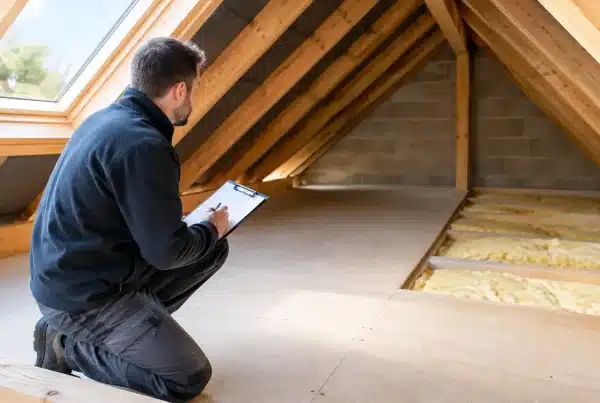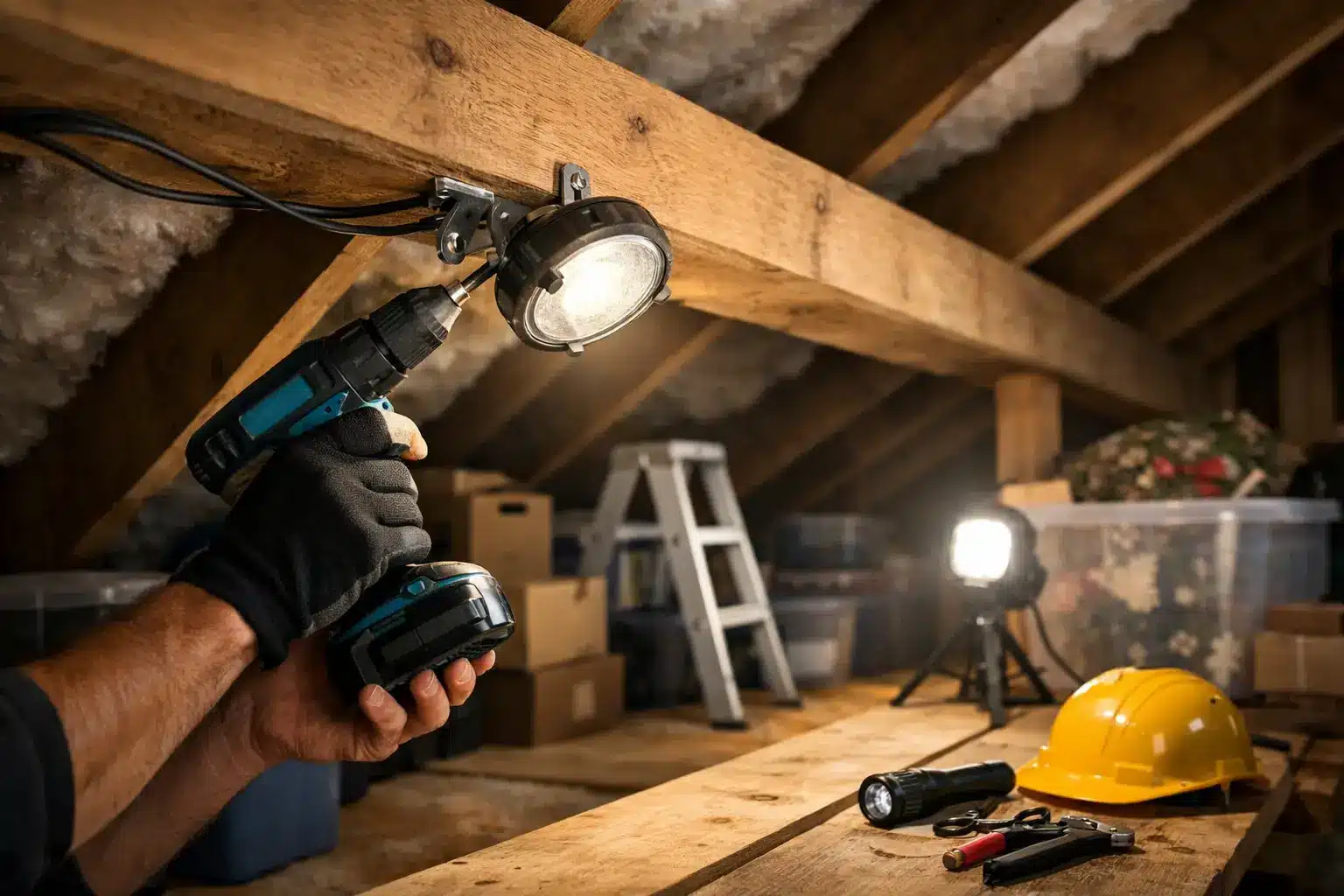
A loft full of boxes is only useful when you can see what is in it. When you fit loft storage lighting properly, retrieving the Christmas decorations, paperwork or children’s clothes becomes a quick job rather than a balancing act with a torch. Good lighting also makes a loft safer to access, particularly where you are moving around boarded areas above insulation.
The best solution is rarely just adding the nearest light fitting. Your loft’s access, boarding layout, roof structure, insulation depth and electrical supply all affect what will work safely and reliably. Planning these details together creates storage space that is genuinely easy to use for years to come.
Why loft lighting should be part of the storage plan
A single bare bulb near the loft hatch can light the entrance but leave the rest of the space in shadow. That may be enough for an occasional inspection, but it is not ideal for a loft used as regular household storage. You need clear light along the route from the hatch to the areas where boxes, suitcases and seasonal items will be kept.
Lighting is most effective when installed alongside raised loft boarding and improved access. A stable, raised walkway gives you a safe route above the insulation, while lighting helps you see the edge of that route, the roof trusses and any items stored nearby. Trying to add it after every corner is packed can mean more disruption and awkward cable routing.
It also gives you the chance to organise the loft sensibly. Keep frequently used items close to the hatch and light the route to less-used storage at the edges. This approach makes better use of the available floor area without treating the loft as a habitable room or overloading the structure.
How to fit loft storage lighting: start with a sensible layout
Before choosing a fitting, consider how you will use the space. Stand at the hatch opening and identify the main boarded route, the central storage area and any low-eaves sections. The aim is even, practical illumination rather than creating a bright living-room effect.
For many lofts, a line of surface-mounted LED battens or enclosed LED fittings works well. These spread light across a wider area and are generally more straightforward to position above a boarded walkway. They are particularly useful in older properties, where roof timbers, uneven shapes and restricted headroom can make a more complex layout unnecessary.
Recessed spotlights can look tidy, but they are not always the right choice in a storage loft. They require suitable clearances, careful attention to heat and insulation, and a sound mounting surface. In a space that is primarily for storage, surface fittings often provide better value, easier maintenance and fewer compromises.
Think about the number of fittings rather than relying on a single powerful lamp. One fitting at the hatch and another along a longer central walkway can be more useful than a bright light at one end. The exact arrangement depends on the loft footprint, but avoiding dark patches matters more than achieving perfect symmetry.
Choose LEDs for low running costs and low maintenance
LED lighting is a practical option for loft storage because it uses little electricity, lasts far longer than traditional bulbs and produces less heat. Choose a neutral or cool white light if your priority is visibility. It makes labels, box contents and the edges of boards easier to distinguish.
Select fittings designed for the conditions in which they will be used. A loft can become very cold in winter and hot in summer, so a quality enclosed fitting is preferable to a fragile open bulb. If the loft may be dusty, a fitting with suitable protection against dust ingress is worth discussing with your installer.
Put safe access before extra brightness
The light switch should be easy to reach as you enter the loft, without stepping off the ladder or leaning across the hatch. A switched light near the hatch is a simple, dependable solution. Where the loft is larger, two-way switching can be useful, allowing you to turn the lights off from a second point before climbing back down.
Motion-sensor lighting can be convenient, especially when your hands are full. However, it should be chosen and positioned carefully. A sensor that switches off while you are sorting through boxes is frustrating, while one that detects movement outside the hatch may operate unnecessarily. Manual switching remains a sensible option for many homes, or it can be used alongside a well-set sensor.
Good loft access makes the lighting safer to use. A properly fitted loft ladder, secure hatch and clear boarded landing reduce the temptation to stretch, climb over joists or balance while trying to find a pull cord. The storage system, access and lighting should work as one practical setup.
Protect insulation and avoid careless cable routes
Loft insulation is there to slow heat loss from the rooms below. Compressing it under standard boards reduces its effectiveness, while laying cables carelessly through it can make future work difficult. A raised loft boarding system preserves the insulation depth and creates an accessible void for services where appropriate.
Cables should be routed neatly, protected from damage and kept away from areas where boxes will be dragged or stacked. They should not be left loose across walkways, trapped beneath boards or stretched over sharp edges. Any penetrations through ceilings or boarded areas need to be made thoughtfully so that the finished space remains safe and tidy.
Avoid covering fittings in insulation unless the manufacturer specifically permits it and the installation has been designed accordingly. This is one reason surface-mounted LED fittings are often a straightforward choice for storage lofts. They can be positioned to provide useful light without creating unnecessary complications around insulation.
In new-build homes, the detail matters even more. Board supports, insulation and electrical additions should be considered as part of a system that respects the property’s construction and warranty requirements. A tailored survey helps identify the right approach rather than applying the same method to every roof space.
Know when an electrician is required
Replacing an existing light fitting is different from adding new wiring, extending a circuit or installing a new switch. Electrical work in a home must comply with the relevant safety requirements, and some work may need testing, certification or notification. The requirements depend on the scope of the job and the property.
For that reason, new loft lighting should be designed and completed by a competent electrician. They can confirm circuit capacity, select suitable cable protection, fit the right controls and test the completed installation. This is particularly valuable if you are also adding sockets, extractor equipment or any other electrical feature to the loft.
Do not use extension leads as a permanent answer to poor loft lighting. They create trip hazards, can be damaged by stored items and are unsuitable as a substitute for fixed electrical work. A professional installation is safer, neater and far more convenient.
Common mistakes that make loft storage harder to use
The most common mistake is treating lighting as an afterthought. Installing boards first and then attempting to run cables around them can add time, cost and avoidable disturbance. Plan the lighting positions before boarding is completed, even if you decide to install the fittings slightly later.
Another is lighting only the hatch. This leaves the route to stored possessions poorly lit and does little to improve day-to-day usability. Equally, installing too many fittings can be unnecessary in a small loft and may complicate the electrical work. The right level of light depends on the size of the boarded area and how often you use it.
Finally, do not store items directly against fittings, cables or roof ventilation paths. Keep a clear zone around electrical equipment and maintain access for future inspection. A well-organised loft is easier to use, but it is also easier to keep safe.
A complete loft upgrade delivers the best result
Lighting has the greatest impact when it forms part of a complete storage upgrade: a safe loft hatch and ladder, raised boarding that protects insulation, clear access routes and properly planned electrical work. This gives you more than a brighter roof space. It gives you storage that feels manageable from the moment you open the hatch.
For homeowners in Cardiff, Newport, Swansea, Bristol and nearby areas, a professional survey can establish what your loft can accommodate and where lighting will make the biggest difference. Loft Ins Space can coordinate practical loft storage improvements around the unique construction of your home.
A brighter loft will not create more floor area, but it can make every usable part of that area easier to reach, safer to navigate and far less likely to become forgotten space.