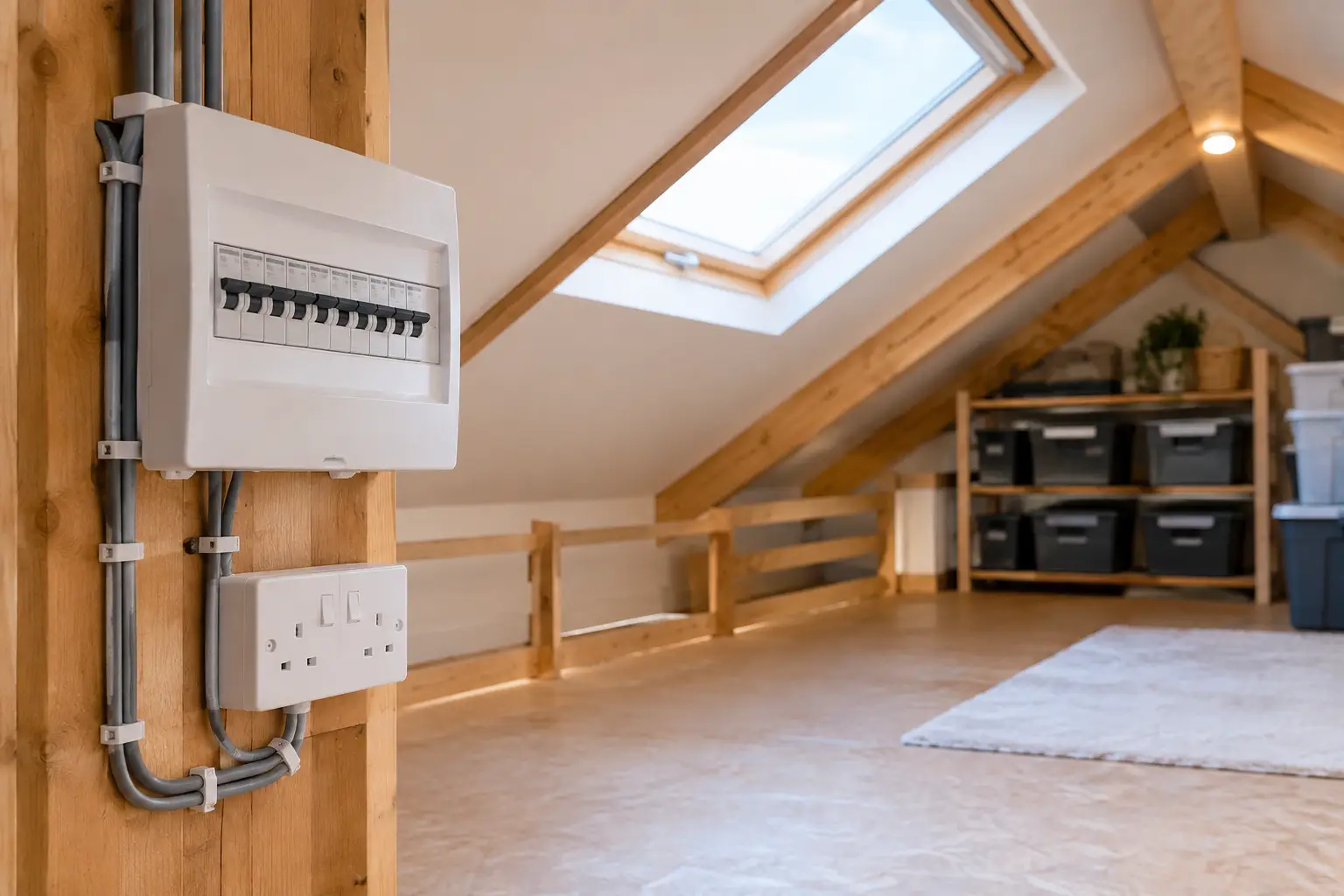
A loft that is dark, awkward and served by one dangling cable is unlikely to become useful storage for long. Safe loft electrics for storage make a real difference to how confidently you can use the space, whether you are putting away seasonal clothes, children’s keepsakes or the boxes that never quite fit elsewhere.
The right lighting, properly planned cabling and sensible power provision can make loft storage safer and more convenient. Just as importantly, the electrical work must work alongside your insulation, boarding and access arrangements – not compromise them.
Start with the way you will use the loft
Electrical additions should follow the storage plan, rather than being treated as an afterthought. A small boarded area near the hatch may only need a well-positioned light. A larger raised loft boarding system with clear walkways, shelving and several storage zones needs more considered lighting so that no corner is left in shadow.
Think about the route from the loft ladder to where boxes will be stored. You should be able to see every step, spot the edge of the boarded area and read labels without balancing a torch in one hand. For many homes, a bright central LED fitting and one or two additional fittings along the boarded route provide better coverage than one powerful light at the hatch.
It also pays to consider who will use the loft. A light that switches on immediately when the hatch opens is helpful when carrying boxes. If access is frequent, a two-way switch, operated from both the loft entrance and within the storage area, can be a practical choice.
Lighting for safe loft electrics for storage
Loft lighting needs to be reliable, cool-running and suited to a space where dust, stored belongings and insulation may be present. Modern LED fittings are usually the sensible option. They use relatively little energy, give good light output and produce far less heat than older halogen lamps.
Position matters as much as brightness. A fitting directly above the hatch can cast shadows across a walkway, while a poorly placed fitting may be blocked as soon as you stack boxes beneath it. A professional survey can identify the practical layout before boarding is installed, allowing cables and fittings to be positioned neatly rather than retrofitted around the finished space.
Avoid relying on a bare pendant bulb where possible. It is easily knocked when moving bulky items, offers uneven illumination and does little to protect the lamp. A suitable enclosed fitting is generally a safer, tidier solution for a working storage area.
Sensor lighting has its place
Motion-sensor lighting is particularly useful for lofts used occasionally. It removes the need to find a switch in the dark and can switch itself off if someone forgets. The trade-off is that some sensors may time out while you are standing still and sorting through boxes. Choosing a fitting with an adjustable timer, or combining automatic lighting at the hatch with manual control inside the loft, often gives the best result.
Sockets: useful, but not always necessary
A socket in the loft can be convenient for charging a cordless tool, powering a small vacuum or carrying out occasional maintenance. It should not be added simply because a socket sounds useful. The loft is a storage space, not normally a room designed for continuous electrical loads.
Any new socket circuit or alteration must be designed and installed properly, taking account of the condition and capacity of the existing consumer unit. A qualified electrician can assess whether the supply, circuit protection and earthing arrangements are appropriate. This is especially relevant in older properties, where electrical installations may have been altered over many years.
Do not run extension leads into the loft as a long-term answer. They can be trapped under hatches, damaged by stored items or create a trip risk across walkways. They also encourage temporary arrangements to become permanent ones. If regular power is genuinely needed, a professionally installed socket is the safer route.
Keep cables clear of boarding and insulation
One of the biggest risks in loft storage projects is treating cables as though they are just another obstacle to board over. They are not. Cables need appropriate support, protection and access, particularly where they pass through or beneath a raised boarding system.
Raised loft boarding is designed to create a usable deck above insulation rather than compressing it. This protects thermal performance and gives a clearer route for services. However, every loft is different. Existing cables may be loosely laid across joists, partly buried under insulation or connected to older fittings that need attention before work starts.
Cables should not be crushed beneath boards, pulled tight around supports or left where boxes can rub against them. Nor should electrical junctions disappear beneath fixed boarding or deep insulation where they cannot be inspected. Any connection that requires future access needs to remain accessible, and unsuitable or ageing connections should be addressed by an electrician before the loft is finished.
This planning is particularly valuable in new-build homes. Homeowners often want extra storage without affecting insulation depth or creating avoidable concerns around their property warranty. A raised system, professionally assessed electrical additions and careful installation offer a more responsible solution than laying chipboard straight over insulation and hoping for the best.
Be alert to existing electrical issues
A loft often reveals the parts of an electrical installation that have not been seen for years. You may find unsupported cables, old light fittings, loose junction boxes or signs that previous work was carried out without much thought for safety. These are not problems to cover up with insulation or boarding.
Before work begins, it is sensible to identify anything that needs an electrician’s attention. Signs worth taking seriously include damaged cable insulation, scorching around fittings, exposed connections, flickering lights, a burning smell or repeated tripping at the consumer unit. If you see any of these, stop using the affected circuit and arrange professional advice.
Electrical work in homes is subject to requirements intended to protect occupants and the property. A competent electrician will work to the relevant wiring standards, assess whether notification is required and provide the appropriate certification for work carried out. This is valuable paperwork to keep with your home records, particularly if you plan to sell in future.
Plan the loft as one complete project
Lighting is easier to install before the final boards are in place. Insulation is easier to protect when its required depth is understood before a boarding system is chosen. A loft hatch and ladder are safer when the entrance is properly lit. These details are connected, which is why a complete plan nearly always produces a better result than arranging each element separately.
At Loft Ins Space, surveys consider how the loft will be used, the construction of the property and the condition of the existing space. Where electrical additions are required, planning them alongside loft boarding, access and insulation helps prevent unnecessary rework and keeps the finished storage area practical.
For households in Cardiff, Newport, Swansea, Bristol and surrounding areas, this joined-up approach can be especially helpful in homes where storage is at a premium. It creates a loft that feels intentional rather than improvised, without the cost and disruption of a full conversion.
A quick safety check before using the space
Once the work is complete, take a moment to check that the loft remains straightforward to use. You should have clear, stable access from the hatch to the storage area, adequate light across all boarded sections and no cables where feet, boxes or ladder movements can damage them.
Keep stored items away from light fittings and avoid overloading the loft with heavy possessions. The boarding system and underlying structure should be used within the limits advised for the property. It is also wise to leave clear access to equipment that may need future inspection, such as water tanks, ventilation components or electrical connections.
A well-lit, professionally planned loft makes storage easier to manage and reduces the temptation to take shortcuts. When every box has a safe route in and out, the space becomes useful from the first day you use it – and remains that way for years to come.