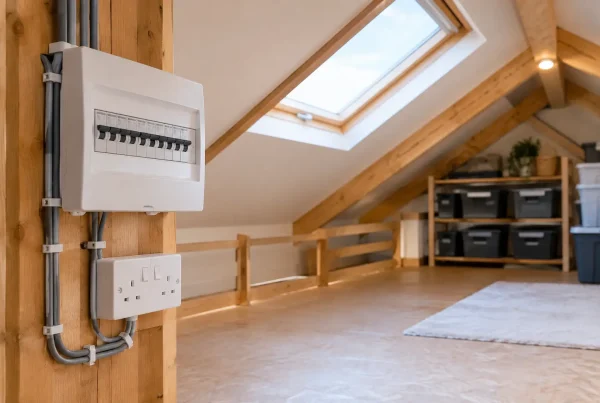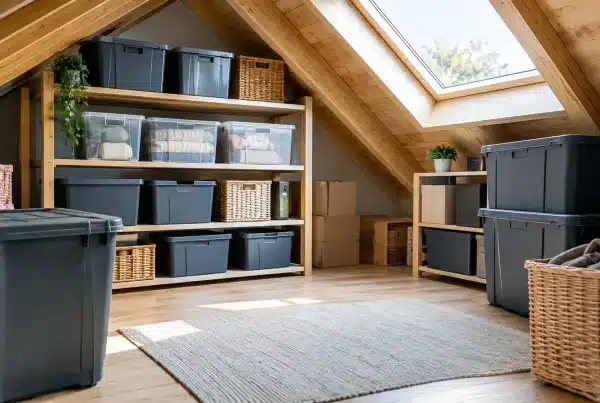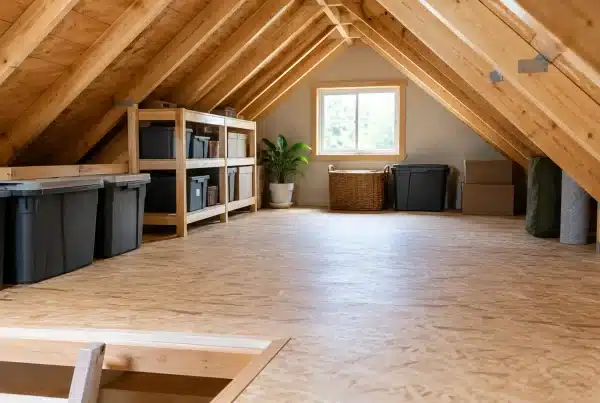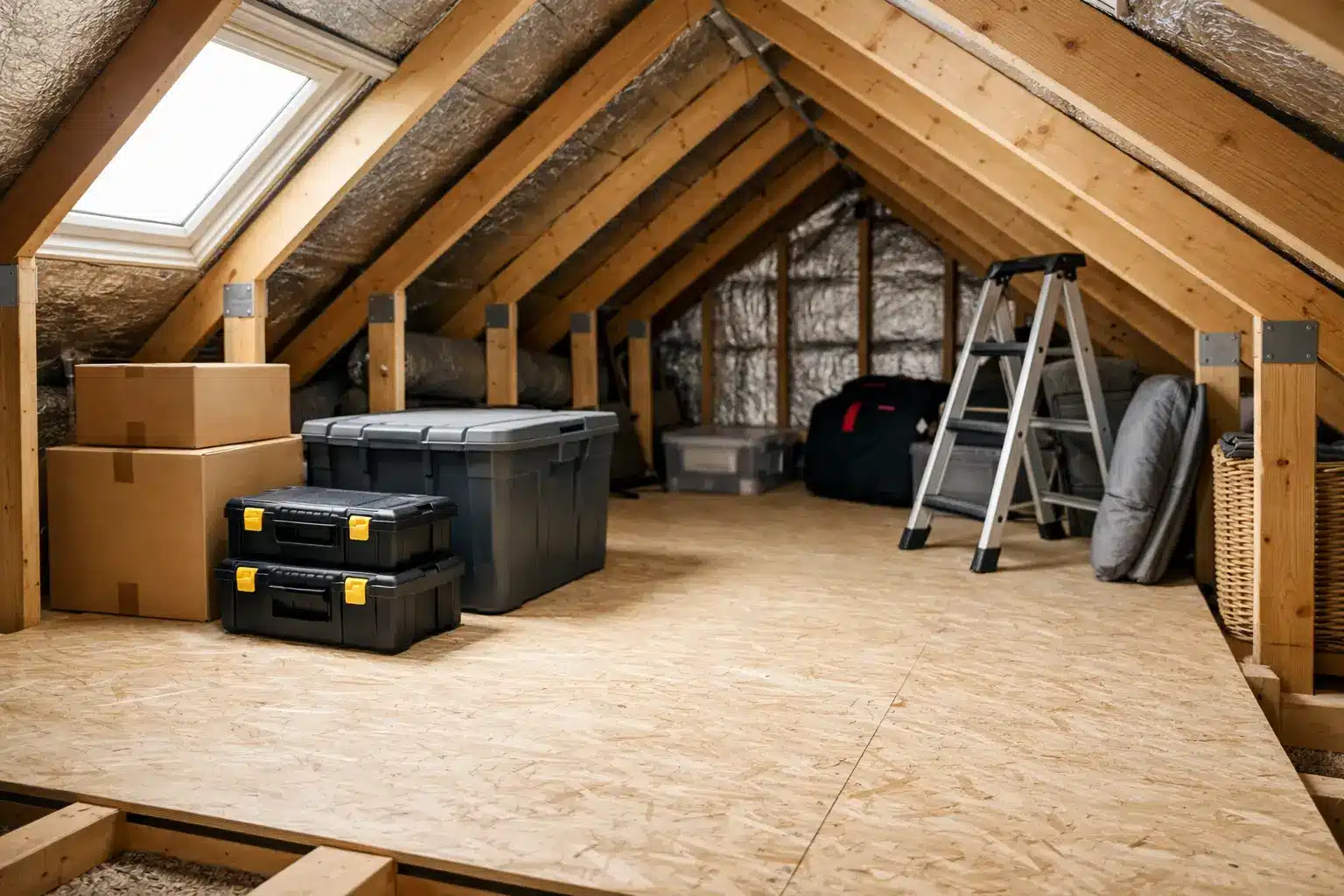
A lot of new-build owners assume their loft is off limits for storage. The hatch is there, the space looks usable, and yet the advice is often vague – don’t squash the insulation, don’t overload the ceiling, and don’t do anything that could affect your warranty. That is exactly why storage loft boarding for new builds needs a more careful approach than a standard loft boarding job.
In a modern home, the loft can become valuable storage space, but only when it is boarded correctly. New-build properties are designed to meet current insulation and energy-efficiency standards, which usually means deeper quilt insulation laid across the loft floor. If boards are fixed directly on top, the insulation gets compressed, ventilation can be affected, and the loft may no longer perform as intended. What looks like a simple DIY job can create problems that are expensive to put right.
Why new-build lofts need a different boarding system
The main issue is height. In many newer properties, the loft insulation sits above the ceiling joists rather than neatly between them. That is good for heat retention, but it leaves very little room for standard boards. If you lay chipboard directly onto the joists, you reduce the effectiveness of the insulation by flattening it.
There is also the question of structure. New-build homes are engineered carefully, and the loft floor is not the same as a habitable floor in a loft conversion. It is generally intended to support the ceiling below and light, sensible storage above, not heavy furniture or concentrated loads. That does not mean the loft cannot be used. It means the storage solution needs to respect the way the property was built.
For many homeowners, warranty compliance is the biggest concern. If your property is still within its NHBC or similar warranty period, any alteration in the loft should be carried out with care. A raised boarding system is often the right answer because it allows storage without compromising insulation depth, and it can be installed in a way that is far more sympathetic to the design of the home.
What storage loft boarding for new builds actually involves
Proper storage loft boarding for new builds is not simply a case of adding boards. The job usually starts with a survey of the loft to assess joist spacing, insulation depth, head height, access, ventilation and the type of items you want to store. That last point matters more than many people realise. Storing suitcases, Christmas decorations and keepsakes is very different from trying to use the loft as a second garage.
The usual solution is a raised loft boarding system. This creates a platform above the insulation so the boards sit clear of it rather than crushing it down. In practical terms, that means you retain the benefit of the insulation while gaining a stable decked area for household storage.
Quality matters here. A purpose-designed, BBA-approved system offers more reassurance than improvised timber spacers or a patchwork DIY approach. In newer homes, that reassurance is worth a lot. You want the loft to be more useful, but not at the expense of energy performance or future snagging concerns.
The benefits of raised loft boarding in a new-build home
The obvious benefit is extra storage, but for most households the real value is convenience. New-build homes are often efficient with living space, yet short on built-in storage. Once you have children’s equipment, seasonal items, paperwork and all the other things that come with everyday life, cupboards fill up quickly.
A properly boarded loft gives those items a defined place. It helps free up bedrooms, airing cupboards and under-stairs spaces without the disruption or cost of a full loft conversion. That is especially appealing for families who need more room to live comfortably but are not looking to alter the structure of the house.
There is also the benefit of safer access. Loft boarding is often paired with a proper loft ladder, upgraded hatch and lighting. That changes the loft from an awkward, dusty void into a practical part of the home. If access remains poor, even a boarded loft tends to be underused.
For homeowners in places such as Cardiff, Newport and Bristol, where moving to a larger property can be expensive, making better use of the loft is often one of the most sensible improvements available. It adds everyday practicality without the cost and planning complexity of larger building works.
Common mistakes to avoid
The biggest mistake is assuming all loft boarding is the same. New-build lofts have specific constraints, and a basic boarding job can work against the property rather than with it. Compressing insulation is the most common problem, but it is not the only one.
Poorly considered installations can block airflow at the eaves, leave no safe route to services, or encourage homeowners to overload areas that were never intended for heavy use. Even small details matter. If the loft hatch is too small, access becomes awkward. If there is no lighting, carrying boxes up and down becomes a risk.
DIY work can also create uncertainty later. If you sell the property, buyers may ask how the loft was altered and whether it was done with the warranty in mind. A professional installation gives you a clearer, more defensible answer.
Is loft boarding allowed in a new build?
Usually, yes – but it depends on how it is done. The loft in a new-build property is not necessarily a no-go area. What matters is whether the boarding system protects the insulation, respects the structural design, and avoids alterations that could create issues under the warranty.
That is why a survey-led approach matters. Some lofts are ideal for storage boarding, while others need a more tailored layout because of trusses, pipework, tanks or limited headroom. In some homes, only part of the loft is suitable for boarding. In others, access upgrades make just as much difference as the storage deck itself.
A reputable specialist should be clear about those limits. If a loft is only suitable for light storage, that should be stated plainly. A good installer does not oversell what the space can do.
What to expect from a professional installation
A well-run loft boarding project should feel straightforward. It starts with a survey, followed by a recommendation based on the property and what you need from the space. From there, the installation itself is usually fast and far less disruptive than many homeowners expect.
In most cases, the result is a clean, raised boarding area with secure access and a much more usable loft overall. If insulation needs topping up, that can often be addressed at the same time. The same applies to loft ladders, hatches and lighting, which helps create one joined-up solution rather than a series of separate jobs.
That joined-up approach is particularly useful in new-build homes because all the elements work together. There is little value in having boarded storage if the hatch is awkward, the ladder feels unsafe, or the loft remains dark and difficult to navigate.
When storage loft boarding for new builds makes the most sense
This kind of upgrade is particularly worthwhile when the home is running out of practical storage, but a full loft conversion would be unnecessary or out of budget. It also makes sense when you want to protect the property’s thermal performance while still using the loft sensibly.
For many households, the sweet spot is simple: they do not want a new room, they want a safer and smarter place to store the things they already own. Raised loft boarding is designed for exactly that purpose.
If your loft has been left untouched because you were worried about damaging insulation or affecting your new-build warranty, that caution is sensible. The answer is not to ignore the space, but to improve it properly. With the right system, storage loft boarding for new builds can give you the extra room you need without creating problems elsewhere.
A good loft should make the house easier to live in. If it does that while protecting insulation, keeping access safe and giving you confidence in the work, it is doing the job it should.